Kellogg’s is no more a stand alone company, divided in two it’s now part of Mars and Ferrero candies.
From the 1950s and into the 80s a box of Kellogg’s cereal was as ubiquitous as a smart phone is today. The Michigan company manufactured its Corn Flakes and Rice Krispies in 20 countries and sold them in dozens more.
In 1952 Kellogg’s came up with Sugar Frosted Flakes and created a friendly tiger to sell them. Tony the Tiger’s “They’re Grrrreat” reverberated in the ears of generations of children. Sugar was quietly dropped from the Frosted Flakes name in the 1980s.
Growing up in Michigan a school pilgrimage to Battle Creek to witness corn flakes being baked was a popular field trip. You knew you were close when the fragrant aroma of toasting cereal floated through the bus. Shrewd marketers, Kellogg’s treated visitors to paper hats and concluded each tour with a cereal variety pack to take home. Kellogg stopped tours in 1986.
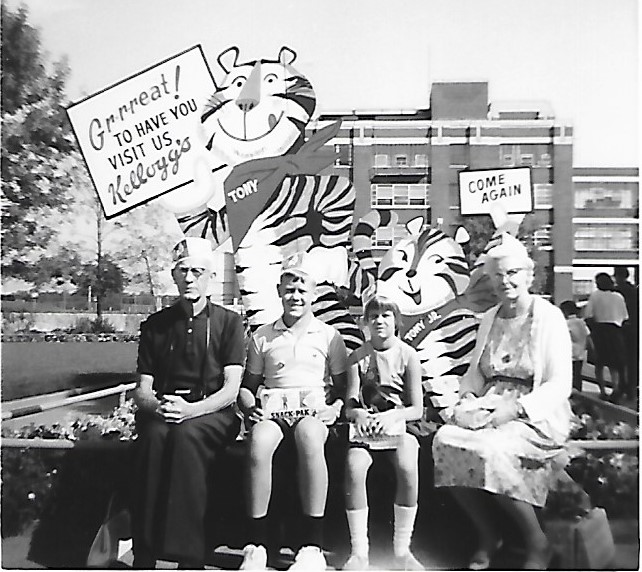
A family visiting Kellogg’s in the 1960s
How this iconic American company shriveled to being a subsidiary of Italian candy maker Ferrero is a complicated story. In a deal that closed in October, the privately held maker of Nutella and sugary Tic Tacs purchased the cereal component of the famous Battle Creek company.
Corn Flakes were invented at Dr. John Kellogg’s medical spa, the Battle Creek Sanatorium, in the 1890s. John’s brother Will launched the Kellogg Company in 1906. Corn Flakes changed the way Americans ate breakfast. Traditional bacon and eggs took too long to prepare while cereal with milk was quick and nutritious. The company came up with more brands—Rice Krispies, Special K, Frosted Flakes, and many more. Kellogg’s became a huge advertiser.
Tastes shift. Consumers wanted sweeter cereals and Kellogg’s obliged. Not only were its products increasingly heavy on sugar, some like Froot Loops were artificially colored. All the while the company prospered.
Cold cereal sales world-wide are in decline. They’ve fallen steadily for 25 years. The market demands faster breakfasts—yogurt, fruit, food bars, muffins, frozen waffles or bagels. Kellogg’s grew to comprise many brands: Frosted Flakes, Froot Loops, Rice Krispies, Corn Flakes, Frosted Mini-Wheats, Special K, Raisin Bran, Kashi, All-Bran, Honey-Snacks, Corn Pops, Pringles, Cheez-It, Pop-Tarts, Eggo, Morning Star Farms, RX Bar, Rice Krispies Treats, Nutri Grain, Town House Club crackers.
In 2001 Kellogg’s moved into cookies, buying Keebler, which makes Girl Scout cookies, for nearly $4 billion. The acquisition didn’t work. Kellogg’s over-paid and in 2019 it sold Keebler to Ferrero for $1.36 billion.
In 2023 Kellogg’s management made a fateful decision. It split the company in two. The more profitable snacks, frozen foods and international part was rebranded as Kellanova, its headquarters moved from out of the way Battle Creek to Chicago. The WK Kellogg Company became a remnant, North American cereals and not much else. It stayed in Battle Creek.
In 2024 Kellanova was purchased by Mars candy for $30 billion. In 2025 Ferrero got heavily indebted WK Kellogg for only $3 billion. The Kellogg name remains.
While Kellogg’s stock is no longer traded, an important adjunct of the company remains in Battle Creek. The WK Kellogg Foundation has $8 billion in assets and is the fifth biggest US-based charitable foundation. By some measures it is bigger than the Rockefeller Foundation and is a major player in children’s health and black empowerment. Its grants exceed $300 million annually.
Battle Creek, a city of 50,000, is no longer Cereal City USA. In the 1970s Kellogg’s employed 4,000 people in Battle Creek. Today that number has shrunk by half. Without a major college or teaching hospital, Kellogg employees typically prefer to live in nearby Kalamazoo. Ferrero promises to keep its cereal headquarters in Battle Creek.
The demise of Kellogg’s is not unlike what happened to other iconic American firms– Xerox, Eastman Kodak, Bethlehem Steel, Motorola. Nor can Kellogg’s fate be attributed solely to corporate greed. Consumers—progressively over the decades– chose sweet foods and snacks over nutrition.
Kellogg’s rode that wave but came up short. #
 Barry D. Wood