BizNews.com The Rational Perspective January 13, 2026
By Barry D. Wood
In Budapest some time ago, I came upon a wall poster bearing the likenesses of potentates whose imperial rule collapsed in the aftermath of World War I. It was an advertisement for a museum exhibit.
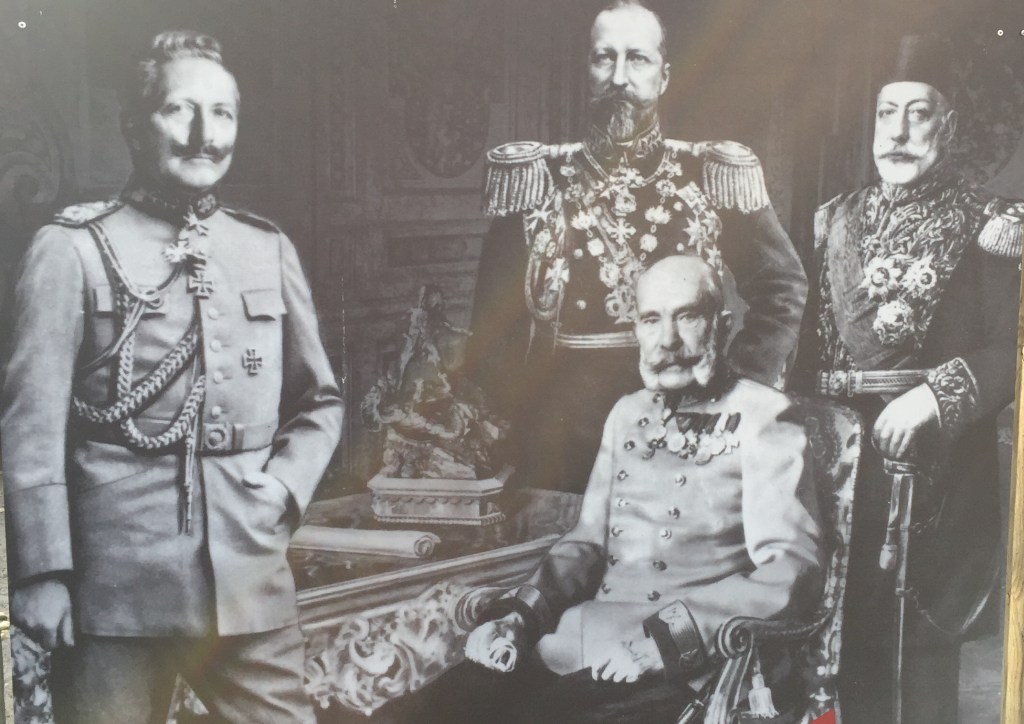
The Hapsburg empire in Vienna of Emperor Franz Joseph (seated) lasted 600 years. But stuck on the losing side of the great war it collapsed in 1918. Similarly, the 600-year Ottoman empire in Constantinople, over which Mehmed V (right) was the last sultan, limped along until toppled by revolution in 1922.
The poster was a reminder that an epoch had ended.
The hugely successful global order in which we live emerged from the devastation of the second world war. An international conference in 1944 created the International Monetary Fund and World Bank to provide emergency cash and development finance to countries in need. The two entities were responses to President Franklin Roosevelt’s belief that economic isolation and high unemployment caused World War II. The Soviet Union was among the 44 nations at the conference but chose not to ratify the Bretton Woods agreement.
A corner stone of the new global order is an open trading system in which countries are treated equally as long as free trade rules are followed. Punitive tariffs, a cause of great depression, were to be avoided.
Despite cold war, the emergence of post-colonial lands, and the clash between socialism and free markets, the US-led system worked and continues to work remarkably well. Edward M. Bernstein, a top treasury at New Hampshire’s Bretton Woods conference, later observed that “the International Monetary Fund was indispensable in preventing the disintegration of the world economy.”
Between 1950 and 2000 trade took off, growing by 4,000%. Living standards rose, economic growth surged, life expectancy increased, infant mortality declined. The United States is a prime beneficiary of the open, rules-based system. Tens of millions of jobs were created, 70 million in the last three decades alone. America became the world’s richest country. The US remains the leader in innovation, unmatched in technological advances. The internet was created in the States. From Apple to Google to Amazon to Uber, Silicon Valley firms dominate the digital economy.
As they became richer western Europe and Japan joined the US in overseeing the global economy. In 1976 the US, UK, Germany, France, Italy, Japan and Canada formed the Group of Seven, its leaders meeting annually in an economic summit. During the global financial crisis of 2008, a broader G20 that included China, India and other developing countries was created. Through tranquility and turbulence, the dollar remained the principal currency in international transactions.
Robert Lighthizer, President Trump’s first trade representative, says the global order began to shudder after China joined the World Trade Organization in 2001.”China,” says Lighthizer, seeks to displace the US as the leading economic power, posing “an existential threat to the United States.” Beijing, he says, has bent free trade rules to its advantage and dumps surplus production on world markets. While ostensibly defending the system, Beijing seeks supremacy with its currency overtaking the dollar.
President Trump has overturned key elements of the post-World War II order, believing that it works against US interests. He has arbitrarily boosted average US tariffs from 2% to 10%. For some countries—particularly China—US tariffs are much higher. Trump blames low tariffs for the US losing one third of its manufacturing jobs over the past decade.
Economist Steve Hanke of Johns Hopkins University is critical of Trump’s tariffs and is convinced they will not revive US industry. Instead, he says, they offend America’s allies, turning friendly countries into adversaries. Mark Carney, Canada’s prime minister, a target of Trump’s ire, says American unilateralism has ruptured the global system.
There are signs that what some call the Pax Americana is coming to an end. Gold, a safe haven in times of uncertainty, has soared, its price rising a stunning 65% in 2025. The dollar, which floats against other currencies, saw its value drop by 10%, its biggest decline since 2017.
Contrary to what many economists predicted, President Trump’s tariffs have not yet triggered either higher US prices or a rise in inflation. Exporters and retailers thus far have swallowed the additional costs, hoping the tariffs are temporary.
The Federal Reserve, the US central bank and guardian of the dollar, has been central to the post-war order. Interest rates set by the Fed tend to guide global activity. With few exceptions the Fed has kept inflation low, thus maintaining global confidence in the dollar. Jerome Powell, Fed chairman since 2018, will retire in May and President Trump will nominate a successor. If his choice is viewed as someone subservient to the president’s desire for low interest rates, there could be a market reaction sending the dollar lower.
The global system created 80 years ago is being tested as never before, not only because of Trump’s unilateralism. Historian Niall Ferguson sees Cold War II, the rivalry between the United States and China, as an equally serious threat. Unlike Russia during the first Cold War, China is deeply integrated into the global economy and its drive for dominance could become destabilizing.
Is an epoch coming to an end? It’s too early to say. #
 Barry D. Wood