HARARE, ZIMBABWE: Arriving at Harare’s renovated, ultra-modern airport, I paid for my tourist visa and stepped outside. There was a line of taxis and I approached one of several men standing and talking next to their vehicles. “How much to central Harare?,” I asked. We agreed on $25 (the US dollar is the currency used in Zim). I gave him a 20 and a five and got into the front seat of Prosper’s small Honda. We chatted amiably during the next thirty minutes. He told me of his two years in Joburg and how he had returned to Zim. The potholes were so numerous and deep that the suspension rattled as we slowly proceeded.
At what turned out to be the wonderful Bronte garden hotel downtown, Prosper parked and turned off the ignition. As we stood next to the opened trunk and I grabbed hold of my bag, I thought it odd that the driver was silent. I said I wouldn’t pay more as I had thought the trip was $20 and the extra $5 was a tip.
Somewhat ominously, Prosper walked with me up the steps and through the lobby. He said he needed more money and at one point said I hadn’t paid. This was not yet a full-blown dispute and our voices were not raised. After checking in, Prosper remained persistent while my demur was equally firm. Then he said he would call the police. I rolled my bag towards the garden, careful that the driver did not see my room number.
Some minutes later the phone rang and the front desk said the police had arrived and wished to see me. I phoned two friends, asking advice as to how I should comport myself. Both replied, stand firm.
The hotel manager arranged a private room off the lobby. Four of us—the driver, a male and female police officer, and a hotel manager– sat in padded chairs facing one another. Conversation was led by Emmanuel, the hotel employee. He asked that I speak. I said in a soft voice that I was surprised that a foreign visitor would be treated this way since I had paid the driver the agreed fare. Did I have a receipt. No, I said, there was no mention of a receipt.
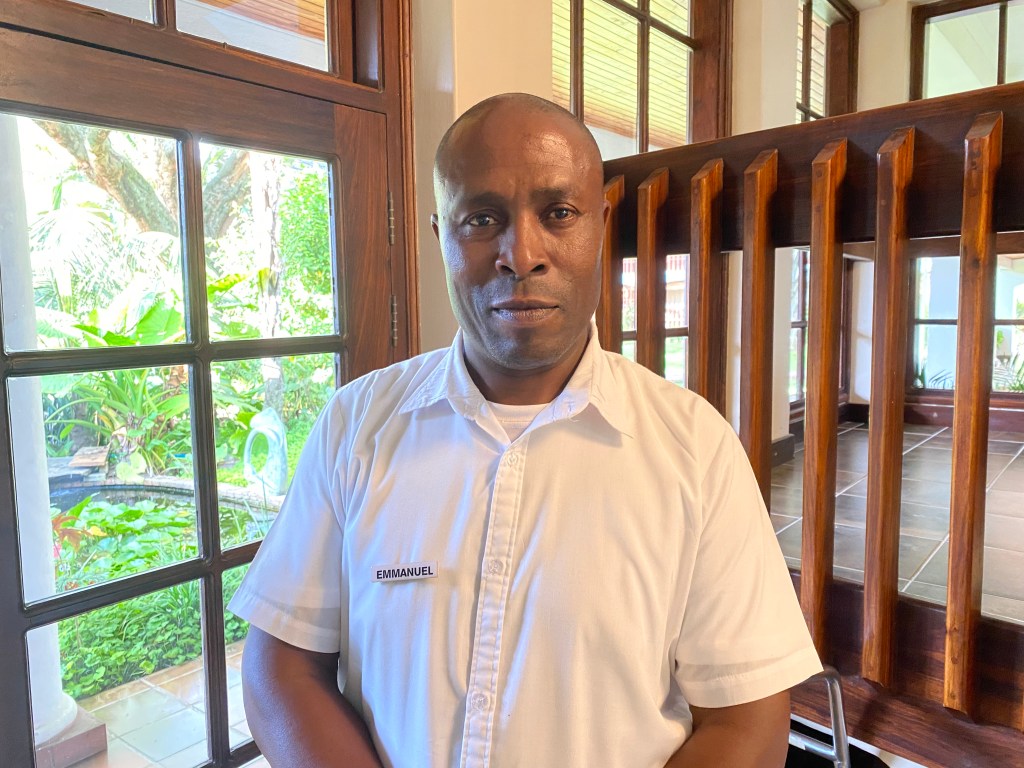
Emmanuel, the very helpful hotel manager
The driver spoke mostly in Shona but also in English. The two police officers were silent. Why didn’t you give a receipt, asked Emmanuel, as that is the regulation. It became clear that I was not the target of this investigation. After ten minutes or so we rose from our chairs and the driver and police departed.
This disagreeable incident in no way damaged my pleasant, rewarding stay in the Zimbabwe capital.
Later I asked Emmanuel what had been going on. He said I had opened my wallet at the airport allowing the driver to see several $20 US notes. He wanted more, said Emmanuel.
Some days later I recalled a similar, more serious incident I experienced some years back in Maputo, Mozambique. Strolling along a downtown street, I was stopped by two soldiers, assault rifles slung over their shoulders. Where were my papers, they asked in English. I said they were in my room, the hotel only a block away. They said I would have to go to prison as they weren’t allowed to leave their posts to visit the hotel. I protested but the soldiers were insistent. They added that since it was Sunday my case couldn’t be heard in court for some days. Then something happened. There were car horns and the sound of brakes. The soldiers turned and moved quickly onto the busy avenue. I was left alone. Certain they weren’t returning for me, I turned and walked slowly back to my hotel.
These are lessons to be learned.#
 Barry D. Wood