Two-hundred-fifty years ago, on October 10th 1774, 2,500 Virginians defeated Chief Cornstalk’s mostly Shawnee warriors at Point Pleasant, WV on the Ohio River. It was the only significant battle in a six-month-long war named after Virginia’s last colonial governor, the Earl of Dunmore, who himself led one of two columns that crossed the Allegheny Mountains into Indian country.
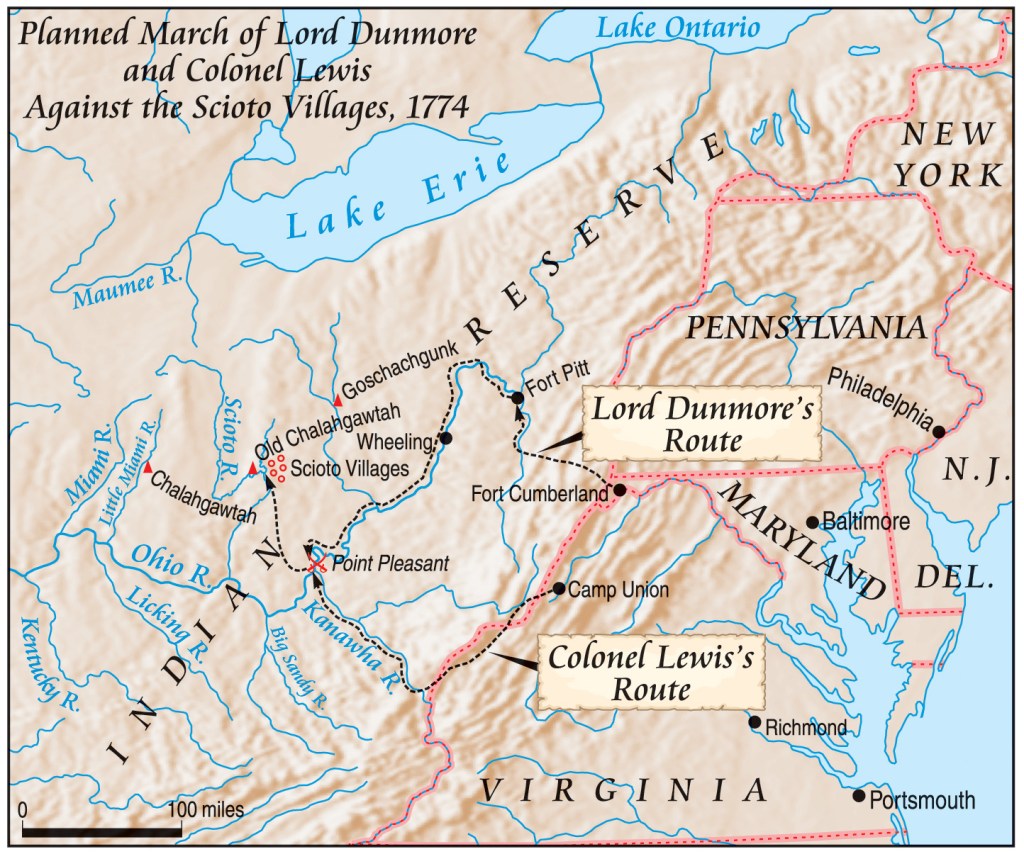
The Virginians sought to end Shawnee, Mingo and Delaware incursions and atrocities on the south bank of the Ohio where they fiercely resisted white settlement. The Virginians objective was the capture of the Shawnee village at Chillicothe deeper on the Ohio side of the river.
Dunmore’s War was the last time an American colonial militia fought under the British flag. It took place as anti-British, revolutionary sentiment was festering and growing in the colonies. In September the first Continental Congress had been convened in Philadelphia and in April 1775 the Revolutionary War would begin with “the shots heard around the world” in Concord and Lexington, Massachusetts.
Control of the vast, largely uninhabited wilderness—the Ohio country—had for decades been a matter of contention between the colonial authorities and native Americans. Under the 1763 Treaty of Paris that ended the French and Indian War, the losers surrendered the northwest territory to the British. Indian tribes friendly with the French objected. Native Americans–whether Shawnee, Iroquois, or other tribes—rightly saw the French presence as largely benign, promoting trade not colonization.
In October 1763 London appeased the Indians through a proclamation safeguarding their hunting grounds and forbidding white settlement west of the Alleghenies. However, that edict was largely ignored as settlers continued to flow west and in 1766 the British amended the proclamation and allowed more white settlement. By the time of the Battle of Point Pleasant perhaps 100,000 whites lived west of the Alleghenies.
Before his promotion to head Britain’s richest American colony, Virginia, Dunmore in 1770 and 1771 had been governor of New York. In Williamsburg he embraced the colonists’ hostility to the Indians and organized the punitive expedition against them. His plan called for a twin pronged attack, one which he would lead from Pittsburgh down the Ohio River. A second column led by Andrew Lewis would march overland to reach the junction of the Ohio and Kenawha Rivers at Point Pleasant.
The combined Virginian militia was formidable. Against them Shawnee chief Cornstalk assembled 800 to 1,000 warriors from various tribes. The fighting was fierce and went on all day. The Virginians lost 75 dead and twice that number wounded. Indian casualties were somewhat less but Cornstalk feared he would be routed and ordered his warriors back across the Ohio. The Virginians gave up their hope of reaching Chillicothe.
Once Revolutionary War fighting was underway Lewis and most of his militiamen took up the American cause. Lewis was made a general by George Washington. George Rogers Clark, a Lewis deputy at Point Pleasant, became a revolutionary hero. Dunmore returned to Williamsburg, Virginia’s capital, but had to flee to Norfolk after Patrick Henry succeeded him as governor. Cornstalk survived, traveled freely, and was respected by most Americans on the frontier. However, while on a peace mission back to Point Pleasant in 1777 Cornstalk was set upon and killed by settlers incensed by Indians having killed and scalped one of their brethren. Patrick Henry called Cornstalk’s murderers, “vile assassins.”
Point Pleasant was another American victory in the ongoing clash of cultures between white settlers and native Americans. Land hungry whites regarded the Ohio country as the edge of civilization, a great wilderness waiting to cleared. For native Americans—constantly being pushed west– it was a sacred hunting ground teeming with game.
The native American tribes, of course, ultimately lost, their resistance respected and even revered. Chief Cornstalk joins Indian leaders including Pontiac, Tecumseh, and Bluejacket in heroically having resisted but ultimately failing to halt white settlement in what would be called the Northwest Territory from which five states would be formed.
(I owe gratitude to scholars James Swisher and Glenn Williams whose work was useful in preparing this article) *

