The Daily Friend October 4, 2026

One hundred years ago, in the summer of 1926, Bill Shirer and Grant Wood sat on the terrace of the Deux Magots café in Paris and sipped white wine.
Aspiring journalist Shirer was 22, painter Wood 35. Both came from Cedar Rapids, Iowa, a town of little consequence in the heart of the Midwest corn belt.
Wood had borrowed $1,000 for this, his third, trip to Paris, the art capital of the world. He was discouraged and broke. Shirer, recently graduated from Coe College, departed Cedar Rapids with $200 in his pocket, headed for Montreal to work his way to Europe aboard a cattle boat. To him the world looked bright, as he had landed a $15 a week job as a copy editor on the Paris Tribune.
In his 20th Century Journey, Shirer recounts that on that August evening Wood said he was going home for good.
“Listen, Bill. I’ve learned…you’ve got to paint what you know….and what I really know is home. Iowa.” He was giving up painting landscapes of the French countryside and Paris, of which he said, “There’s not one that the French impressionists didn’t do a hundred times better!” Wood sighed, “I’m going to paint those damn cows and barns…and cornfields and the women in their aprons and the men in their overalls.”
Shirer said his friend whose Cedar Rapids studio was across the street from the Shirer home had reached a turning point. Grant Wood did return to Iowa and began painting local scenes. There, wrote Shirer, the painter “found himself, and his genius unfolded.”
Wood’s talent burst onto the American art scene in 1930 when his American Gothic won fifth prize at a competition in Chicago.
Painted in oils during the first year of the great depression, the portrait offers a harsh look at rural America. It depicts a stern, weathered farmer and his taciturn, matronly daughter wearing an apron. Behind them stands the farmer’s barn and simple board-and-batten home, pointing upward, Gothic style. Critics couldn’t decide whether the artist was ridiculing rural life or praising it.
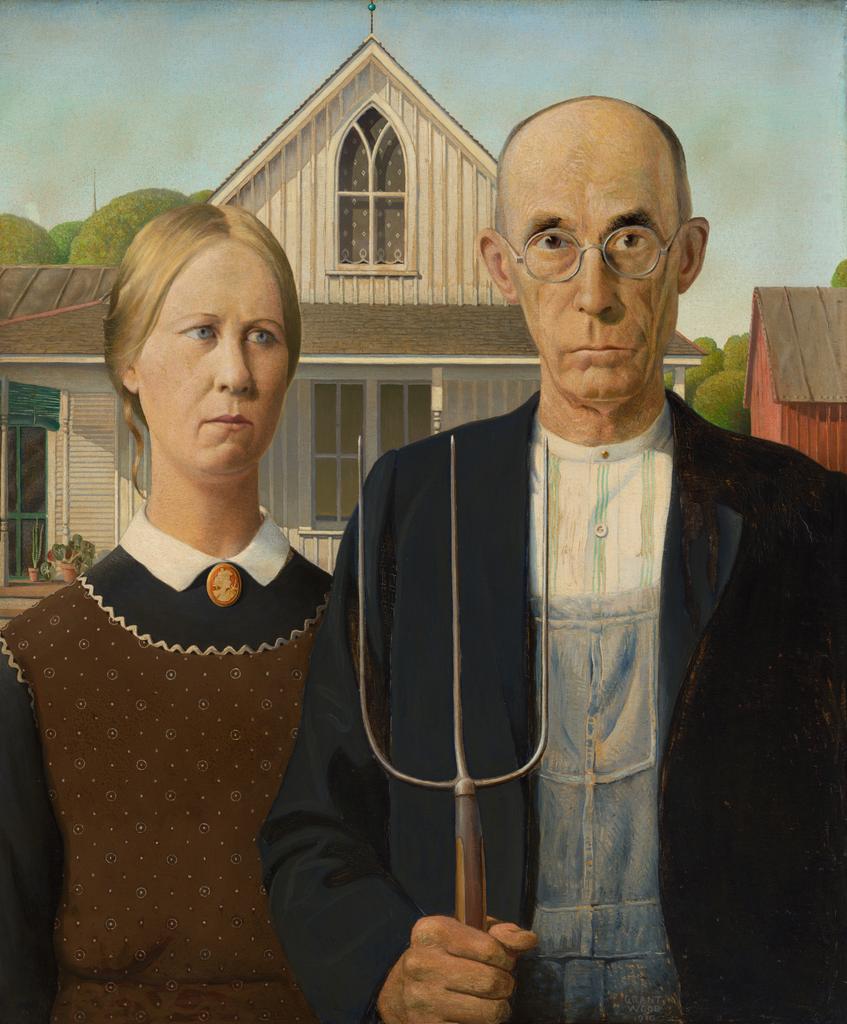
American Gothic, Grant Wood [https://en.wikipedia.org/wiki/American_Gothic#/media/File:Grant_Wood_-_American_Gothic_(1930).jpg]
American Gothic quickly became one of the best-known American paintings. The Chicago Art Institute purchased the canvas for the price Wood asked, $300. It remains a centerpiece of its permanent collection.
Shy and withdrawn, Grant Wood remained in Iowa painting and teaching but died young of pancreatic cancer at 50.
Bill Shirer marched to a different drummer. For him, small town Iowa was a wasteland, narrow-minded and confining. Inspired by progressive thinkers in high school and college, Shirer fled Iowa’s cultural poverty. He wrote: “I could never go back to those arid surroundings that had helped shape me.”
Shirer remained in Europe for 15 years, rising to be among the most authoritative of foreign correspondents, variously reporting from Vienna, India, Rome and Berlin. He ranked at the top of his profession and was fluent in French, German and Italian. He married an Austrian photographer, and in 1937 was the first hire in Ed Murrow’s team of journalists for CBS Radio.
He escaped Hitler’s Germany in December 1940 upon learning that the Gestapo planned his arrest for treason, which carried the death sentence. Shirer’s first book, Berlin Diary, was published in 1941.
Following the war and back in the US, in 1947 he sparred with Murrow over advertisers influencing news coverage and left CBS in disgust. He was never reconciled with Murrow, and became embittered.
Accused of communist sympathies, Shirer endured 12 years in the journalistic wilderness, unable to find work and ending the 1950s “flat broke.”

William Shirer in the 1940s
Shirer’s fortunes changed in 1960 when his Rise and Fall of the Third Reich became a huge best-seller that is now regarded as the definitive account of Hitler’s Germany.
Reflecting on Wood, Shirer wrote admiringly, “He embodied the wonder and beauty of human fortitude.” Wood had, Shirer wrote in 20thCentury Journey, “fought through grinding poverty, disappointments, false starts and setbacks.”
The professional achievements of Grant Wood and William Shirer endorse Mark Twain’s dictum: to write what you know, or in the case of Wood, paint what you know. Wood’s resolve came in that 1926 summer in Paris. For Shirer – 13 years younger – it came from living through Europe’s trauma of the 1930s and 40s.
Visiting Cedar Rapids in 2018, I found abundant civic pride for Grant Wood but none for Bill Shirer. His name was little-known, while Wood’s studio had been reconstructed, enclosed in a modern building and gift shop.
Strolling through the pleasant, small Coe College campus I found no bust or portrait of its illustrious graduate, even though Shirer chose Coe over the Library of Congress as repository for his papers.
Shirer wrote of his time at Coe College: “I had learned a little, or at least had learned the most important thing of all: that college was but a step in an education that I was determined to pursue all the rest of my life.”
*Barry D. Wood is not related to Grant Wood.
The views of the writer are not necessarily the views of the Daily Friend or the IRR.
If you like what you have just read, support the Daily Friend

Barry D. Wood
Washington writer Barry D. Wood for two decades was chief economics correspondent at Voice of America News, reporting from 25 G7/8, G20 summits. He was the Washington correspondent for RTHK radio in Hong Kong from 2012 to 2025. Wood’s earliest reporting included covering key events in South and southern Africa, among them the Portuguese withdrawal from Mozambique and Angola and the Soweto uprising in the mid-1970s. He is the author of the book Exploring New Europe, A Bicycle Journey, based his travels – by bicycle – through 14 countries of the former Soviet bloc after the fall of Russian communism. Read more of his work at econbarry.com. Watch https://www.youtube.com/watch?v=07OIjoanVG


.jpg)